
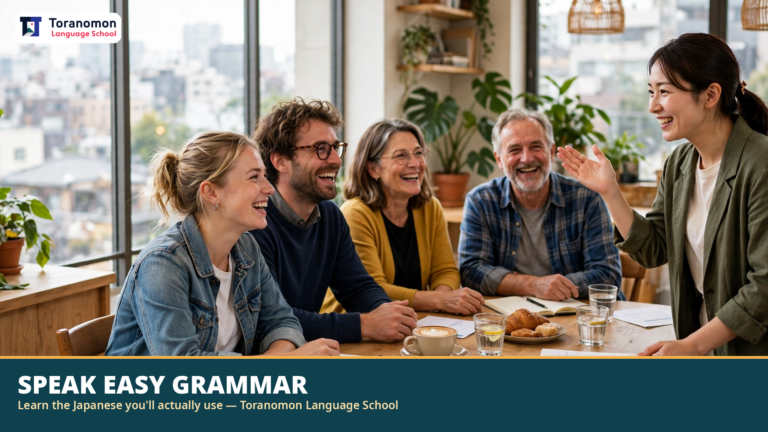
Practical conversation for daytime and evening learners, at every level.
Introduction: Textbook Japanese vs. Real-Life Japanese
You’ve studied the grammar. Maybe you’ve used apps, maybe you’ve taken classes. But when a restaurant server asks you a question, or a colleague shares an idea in a meeting, the sentence you need just doesn’t come out.
It’s not that you’re not trying. Most learners have plenty of input and very little speaking practice in real situations. We believe Japanese should help you handle daily life, work, and friendships.
Four Hacks, One Phrase Each
People should learn Japanese differently, depending on your level and your lifestyle. Here’s one handy phrase for each level. Find the one closest to you and try it this week!
For Beginners
| DAYTIME LESSON • DAILY SURVIVAL HACK Situation A: At a restaurant, you are first confronted with these two sets of questions from the staff at the entrance. ご予約はありますか? 何名様ですか? Goyoyaku wa arimasu ka? Nanmei-sama desu ka? / “Do you have a reservation? How many people?”) YOUR PHRASE (NO RESERVATION):予約ありません。二人です。よやくしてないです。ふたりです。 (Yoyaku arimasen. Futari desu.)“I don’t have a reservation. Two people.” ( One person, two, three, four, five, etc…: hitori, futari, san-nin, yo-nin, go-nin, etc. ) YOUR PHRASE (WITH A RESERVATION):xxです。二人です。Xx です。ふたりです。 ( [Your name] desu. Futari desu.)“. It’s under [name]. Two people.” ( One person, two, three, four, five, etc…: hitori, futari, san-nin, yo-nin, go-nin, etc. ) Tip: Listen for 予約 (yoyaku) and 何名 (Nanmei-), then show the number with your fingers. Try it at lunch with a friend this week! |
| EVENING LESSON • DAILY SURVIVAL HACK Situation B: You’ve just started working in Japan. A colleague speaks quickly and you can’t catch it. YOUR PHRASE:すみません、もう一度お願いします。すみません、もういちどおねがいします。 (Sumimasen, mō ichido onegai shimasu.)“Excuse me, one more time, please. ”Tip: Asking for clarity is not rude. Starting with “Sumimasen” (Excuse me) keeps it soft. You can ask for “Mo ichido” (One more time) repeatedly until you get the meaning. “Onegaishimasu” (Please) is the all-mighty word that gets most of your job done throughout the day. Try this phrase in tomorrow’s meeting! |
For Intermediate
| DAYTIME LESSON • EMERGENCY HACKS (AT HOME AND WORKPLACE)Situation: Your washing machine breaks, and you need to call customer service. YOUR PHRASE:洗濯機が動かなくなったんですが…せんたくきがうごかなくなったんですが… (Sentakuki ga ugokanakunattandesuga…)“My washing machine has stopped working, and…” Tip: Ending with んですが… opens the door to your request. Just change the first part, like 子どもが熱を出したんですが… (Actually, my child has a fever, I wonder if you can help me…), and it works for schools and clinics too. People will be much more attentive and helpful if you end your sentences with んですが… rather than just plain masu form and keigo. |
| EVENING LESSON • DAILY SURVIVAL HACKSituation: In a meeting, you want to connect your idea to what a Japanese colleague just said. YOUR PHRASE:それでいうと、〇〇はどうでしょうか?それでいうと、〇〇はどうでしょうか? (Sore de iu to, ○○ wa dō deshō ka?)“Speaking of which, how about ○○?” Tip: Handy when you’d like to offer a different opinion softly. Linking it to what was just said makes your idea sound like a natural next step, not a clear disagreement. |
For Advanced
| EVENING LESSON • READING BETWEEN THE LINES HACKSituation: After your proposal, a client says:前向きに検討します。(まえむきにけんとうします。/ Maemuki ni kentō shimasu. / “We’ll consider it positively.”)It sounds encouraging, but in Japanese business it can mean anything from a real “yes, we’re interested” to a soft “no” that avoids saying no directly. You can’t tell which, and you’d like to find out without pushing. YOUR PHRASE: A)もし差し支えなければ、気になる点を教えていただけますか?もしさしつかえなければ、きになるてんをおしえていただけますか? (Moshi sashitsukae nakereba, kininaruten o oshiete itadakemasuka?)“If you don’t mind, could you tell me if there’s anything on your mind?” B) 現時点でなにかご質問などありますか?げんじてんで なにかごしつもんなど ありますか? (Genjitende nanika goshitsumon nado arimasuka?)“Are there any quesions at this point? ”Tip: Asking about 気になる点 (points on their mind: possible bottlenecks) or 現時点でのご質問(questions at this point)instead of “Is it a yes or no?” lets them share their real concerns without losing face. Their answer, whether it’s a concrete concern or a vague reply, tells you a lot. |
| QUICK OVERVIEWQ: What is Speak Easy Grammar at Toranomon Language School?Speak Easy Grammar is a practical conversation course in Toranomon Language School designed for daytime and evening learners, including busy professionals, parents, and expats. It takes place at the heart of Tokyo business hub, WeWork Toranomon, so the dialogues are real, clear, and sophisticated. Both daytime and evening tracks are offered in a flexible Hybrid format (In-person & Online option available). It turns textbook grammar into immediate spoken Japanese through real-life scenarios, helping you handle daily life, workplace meetings, and friendships with confidence from your very first week. |
Why Learners Choose Speak Easy Grammar
- Speaking first: You use Japanese in every lesson.
- Real situations: Every phrase comes from a place you’ll actually go.
- Learn with others: You practice and build connections at the same time.
- Flexible for your life: Daytime, evening and online.
What Is Speak Easy Grammar?
Speak Easy Grammar is a group course built around real situations in Japan. In every lesson, you’ll speak out loud, practice phrases you’ll use the same day, and learn together with other people who are building their lives here.
We offer two lesson styles, because our learners’ lives are different.
| Track | Target Learners | Core Benefits & Features | Format & Setting |
|---|---|---|---|
| Daytime LessonsBeginner – Intermediate | For parents, freelancers, and anyone available during the day | • Learn the local phrases you need for your neighborhood, cafés, and supermarkets• Practice with peers, make friends, and build a network in Japanese• Build speaking confidence now for future job hunting or returning to work in Japan | Hybrid(In-person & Online option available)Toranomon Lounge & Online |
| Evening LessonsBeginner Intermediate– Advanced | For busy professionals | • Short, output-focused sessions that fit around work• Makeup lessons if you miss a class & video review• Join online from the office, home, or while traveling• A WeWork environment to meet people in similar fields before, during, and after lessons• Lessons available at locations beyond Toranomon | Hybrid(In-person & Online option available)Toranomon WeWork & Online |
| Free Consultations Are Open Not sure where to start? Tell us about your life in Japan, your level, and what you’d like to be able to say.We’ll help you find the lesson that fits you best. Book your free consultation Here→(https://booking.toranomon-ls.com/book-online?category=ff0cd35e-ac4f-4f26-9b1d-4d87acd8cc03) |