
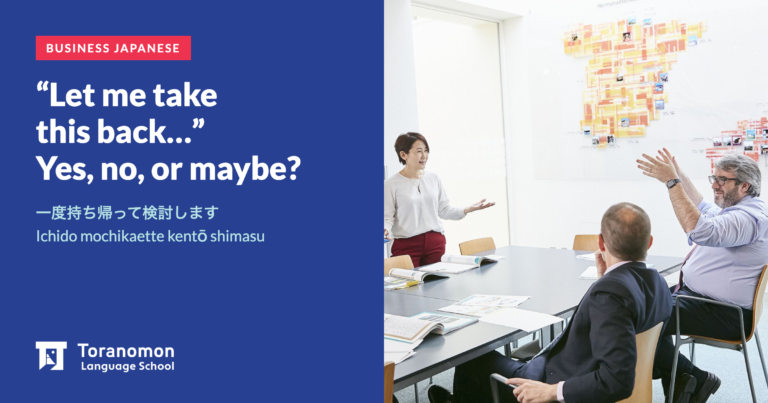
Ichido mochikaette kentō shimasu (一度持ち帰って検討します) means “Let me take this back and consider it.” It tells you the decision will not be made in the room. Sometimes it is a sincere next step; sometimes it is a polite way to say no. The clues are in what comes next: a timeline, follow-up questions, or a named decision-maker usually mean real interest.
You finish your pitch. The room nods. Then the most senior person says, calmly, “Ichido mochikaette kentō shimasu.” Everyone bows, the meeting ends, and you walk out unsure whether you just won, lost, or are somewhere in between.
If that moment sounds familiar, you are not alone. At Toranomon Language School (Minato-ku, Tokyo), this is one of the phrases our business learners ask about most. Your textbook taught you kangaemasu (“I’ll think about it”). Real meetings use something longer, softer, and much more loaded.
What does “ichido mochikaette kentō shimasu” mean?
It means “We’ll take this back to our team and consider it.” The speaker is signalling that the decision belongs to a group or a process, not to the person sitting in front of you.
Let’s break it down:
- 一度 (ichido) – “once” or “for now.” It frames the pause as a single, temporary step.
- 持ち帰って (mochikaette) – “take it back (home).” In business, “home” means the office, the team, the boss.
- 検討します (kentō shimasu) – “we will examine / consider it.” More formal than kangaemasu.
You will also hear the more polite version, ichido mochikaette kentō sasete itadakimasu (一度持ち帰って検討させていただきます). The meaning is the same; the tone is more deferential.
Textbook vs. real: how the decision phrases actually sound
In real meetings, people rarely say a bare yes or no on the spot. They choose a phrase that shows where the decision stands and protects the relationship.
| Textbook | Real | Nuance |
|---|---|---|
| 考えます (Kangaemasu) – I’ll think about it | 一度持ち帰って検討します (Ichido mochikaette kentō shimasu) | The decision is not mine alone; I need to check with my team. |
| わかりません (Wakarimasen) – I don’t know | 社内で確認して、改めてご連絡します (Shanai de kakunin shite, aratamete go-renraku shimasu) | “I’ll check internally and get back to you.” Commits to a reply. |
| はい (Hai) – Yes | 前向きに検討します (Maemuki ni kentō shimasu) | “We’ll consider it positively.” Encouraging, but still not a yes. |
| いいえ (Iie) – No | 今回は見送らせていただきます (Konkai wa miokurasete itadakimasu) | “We’ll pass this time.” A clear, polite no. |
Notice the pattern: the more formal and indirect the phrase, the more it is doing relationship work as well as information work.
Is it a real “maybe” or a polite “no”?
It can be either, and the phrase alone will not tell you. Look at what surrounds it: a timeline, questions, and named next steps point to real interest; silence and a quick change of topic point the other way.
Signs it is a genuine next step:
- They ask for your slides, a quote, or more detail.
- They mention who decides (buchō – the department head, or jōshi – “my manager”).
- They give, or accept, a rough timeline.
- The questions before the phrase were specific (budget, schedule, implementation).
Signs it may be a soft no:
- No questions, no request for materials.
- No timeline, even when you ask gently.
- The conversation moves quickly to small talk and the goodbye.
The safest move is not to guess. Ask a light follow-up question, which brings us to the most useful skill.
How to respond when you hear it
Acknowledge politely, then ask one gentle question about timing or what they need. This keeps the door open without pressuring anyone, and it gives you real information.
| Situation | Japanese | Meaning |
|---|---|---|
| Ask about timing | 承知しました。いつ頃お返事いただけそうでしょうか。(Shōchi shimashita. Itsu-goro o-henji itadakesō deshō ka.) | Understood. Around when might we hear back? |
| Offer support | ご検討にあたって、追加で必要な資料はありますか。(Go-kentō ni atatte, tsuika de hitsuyō na shiryō wa arimasu ka.) | Is there anything else you need for your review? |
| Ask about criteria | 恐れ入りますが、ご判断のポイントを伺ってもよろしいでしょうか。(Osoreirimasu ga, go-handan no pointo o ukagatte mo yoroshii deshō ka.) | Sorry to ask, but may I ask what your decision will depend on? |
Osoreirimasu ga (恐れ入りますが) is a cushion phrase. Putting it before a question makes a direct request feel considerate rather than pushy.
How to use it yourself
Use it when you genuinely need to consult someone, and add a date. A deadline turns the phrase from vague to trustworthy, which matters even more when you are the non-Japanese person in the room.
Try this:
一度持ち帰って、チームと相談してから、金曜日までにご連絡します。
Ichido mochikaette, chīmu to sōdan shite kara, kin’yōbi made ni go-renraku shimasu.
“Let me take this back, discuss it with my team, and get back to you by Friday.”
Then keep the promise. Following up on the day you named builds credibility quickly in a Japanese workplace.
Seen this way, mochikaette kentō shimasu is less a dodge than a description: “This now enters our process.” It also avoids a direct refusal in front of others, which helps everyone keep face.
Speak Easy Grammar: Japanese you’ll actually use
Want to practise phrases like this out loud, not just read about them? Speak Easy Grammar is our practical conversation group course, built around real situations in Japan. In every lesson, you speak, practise phrases you can use the same day, and learn together with other people building their lives and careers here.
Daytime lessons (beginner to intermediate): for parents, freelancers and anyone free during the day.
Evening lessons (beginner to advanced): short, output-focused sessions that fit around work, with online access and makeup lessons if you miss a class.
Learn more about Speak Easy Grammar Course
FAQ
Does “mochikaette kentō shimasu” always mean no?
No. It means the decision will be made later, by a team or a process. It can lead to a yes. Look for a timeline, follow-up questions, or a request for materials as signs of real interest.
How should I reply when a Japanese client says it?
Thank them, then ask one gentle question, such as “Itsu-goro o-henji itadakesō deshō ka?” (Around when might we hear back?). It keeps the conversation open without pressure.
Can a non-Japanese professional use this phrase?
Yes, and it sounds natural in meetings. Add who you will consult and when you will reply, for example “chīmu to sōdan shite, kin’yōbi made ni go-renraku shimasu.”
What is the difference between “kentō shimasu” and “kangaemasu”?
Kangaemasu is personal and casual: “I’ll think about it.” Kentō shimasu is formal and organisational: “We will examine it.” In business, kentō is the expected choice.
Where can I practise business Japanese like this in Tokyo?
Toranomon Language School in Toranomon, Minato-ku, Tokyo offers customised business Japanese lessons face-to-face, online, hybrid, or at your office. You can start with a free online consultation.
Ready to stop guessing in meetings?
Tell us about your meetings, your level, and the moments where Japanese still feels uncertain. We’ll suggest a private lesson plan built around your real meetings and your schedule.