
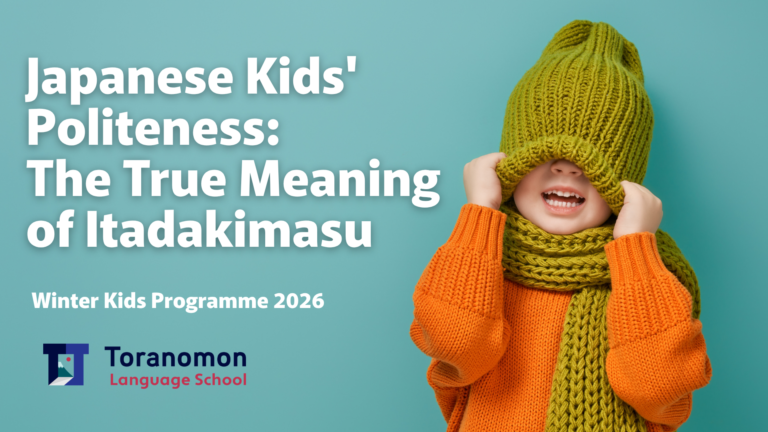
Foreigners are often amazed by how naturally polite Japanese children are, whether they’re bowing, greeting others or cleaning up after themselves. These behaviours are not forced through strict discipline, but are absorbed naturally from Japan’s cultural and educational environment.
For families who frequently visit Japan, allowing your children to experience this ‘culture behind the language’ is invaluable.
Teaching gratitude through meals
‘Itadakimasu’ そして ‘Gochisosama’ are essential at the Japanese dining table, but they mean much more than just ‘Let’s eat’ and ‘I’m done’.
- ‘Itadakimasu’ shows gratitude for ‘receiving life’ from the ingredients on your plate.
- ‘Gochisosama’ thanks everyone involved in bringing the food to the table, from the farmers who grew the ingredients to the person who cooked the meal.
 A quick note:
💡 At Toranomon Language School’s Winter Kids Programme, we practise these greetings daily before breaks and lunches. Rather than just memorising vocabulary, your child will experience the heart of Japanese culture through daily habits. 👉 [Learn more about winter kids programme]
Compassion and discipline blended into daily life
Japanese politeness extends beyond mealtime. In Japanese educational settings, children naturally learn:
- Cleaning up their own spaces: Fostering responsibility and consideration for the next person who will use the space.
- Bowing while greeting others: Expressing respect for others with their whole body.
These behaviours are rooted in a culture that values group harmony and respect. Developing this ‘consideration for others’ from an early age builds essential soft skills for global collaboration.
Since standard sightseeing rarely provides opportunities to learn this ‘everyday etiquette’, children need an immersive environment in which to experience this living culture firsthand.
Go Beyond Language This Winter Break
Children can’t grasp the true charm of Japan just by sightseeing. That’s why the Winter Kids Programme at Toranomon Language School prioritises real-life experiences.
-
Practical Daily Skills: As well as learning classroom etiquette, students take a 20-minute daily break to experience shopping at a convenience store. They choose items and interact with staff at the till, gaining practical language skills.
-
‘Walk and Learn‘ Events: Our bi-weekly event takes students to science museums or art galleries, where they can absorb new knowledge and language in a fun, active setting.
Give your child the gift of a special winter break in Tokyo, where they can immerse themselves in Japanese culture and experience the living language first-hand.
2026/2027 Winter & Spring Kids Programme Schedule
Choose between Morning (9:30-12:00) or Afternoon (13:00-15:30) sessions to fit your holiday plans!
(Each session includes a 20-minute daily break)
Winter Programme: 11th – 30th December 2026
Spring Programme: 19th March – 9th April 2027
🎁 Early Registration Campaign – Until 31st October 2026! Register by the end of October and the 16,500 yen registration fee will be completely waived. With small class sizes and many returning families, places are strictly limited.