
Life in Japan No Longer Chaotic

It’s not that you’re not trying — it’s just really hard at the beginning in Japan Many newcomers arrive in Japan believing basic English is enough—until everyday life suddenly becomes stressful. From convenience store checkouts to restaurant orders and train stations, language barriers turn simple moments into daily struggles. The Survival Kit Japanese Course was created for those who don’t need fluency yet—just the confidence to get through daily life. The Top 3 Situations That Trip Up Newcomers in Japan Newcomers to Japan most often get stuck in three key situations: shopping and checkout, ordering at restaurants, and asking for directions on public transportation. Not understanding prices or payment methods, […]
Why Learning Japanese in a Group Is Effective!

When you start learning Japanese, one of the most important decisions you’ll make is how you study. Apps, textbooks, and self-paced online lessons all have their place—but if your goal is to build real communication skills, confidence, and momentum, a structured group learning environment offers advantages that solo study simply can’t match. Whether you’re living in Japan, planning a future move, or looking to upgrade your career prospects, joining a Japanese group course can accelerate your progress in meaningful ways. Here’s why: 1. You Practice Real Conversation From Day One Language is meant to be used, not memorized. In a group course, you’re constantly exposed to natural speech patterns, different […]
Survival Japanese: Trial Lesson for ¥2,000

The first month of living in Japan is often described as magical, disorienting, and overwhelming—all at once. You’re surrounded by a new culture, a new language, and an entirely different rhythm of daily life. Suddenly, even simple tasks like buying toothpaste, ordering lunch, or figuring out the right train transfer become small challenges. Without the language, everyday life can quickly become a cycle of quiet frustrations. You arrive, receive your residence card, and maybe you’ve memorized a few greetings. But real life begins immediately. You’re handed a form at the ward office—with no English support. A cashier asks you something you weren’t prepared for. You order food without knowing what’s […]
Beginner-Friendly Japanese Vocabulary to Survive Your First Year in Japan
Moving to Japan is exciting, but it can also be overwhelming—especially when it comes to language. Even if you’ve studied Japanese before arriving, you may struggle in everyday situations like commuting, shopping, dining, and interacting with colleagues. Learning essential words and phrases can help you navigate daily life confidently. Here’s an extensive list to get you started. 1. Transportation & Commuting 2. Shopping & Daily Essentials 3. Dining & Food 4. Housing & Daily Life 5. Work & Office 6. Social & Daily Interactions 7. Numbers, Time, & Dates 8. Emergency & Safety Mastering these essential words will help you navigate your first year in Japan with confidence, independence, and […]
Mastering Japanese Business Emails: Key Phrases Every Professional Should Know

For many foreign professionals working in Japan, one of the biggest challenges isn’t meetings, presentations, or small talk—it’s writing Japanese business emails. Even if you can speak conversational Japanese, business writing often feels like a completely different language: formal, indirect, structured, and full of set expressions that are rarely taught in textbooks. But once you understand the patterns, Japanese emails become predictable, clear, and easier to master. This guide covers the essential structure, the must-know phrases, and the professional writing habits you’ll need to communicate confidently in any Japanese workplace. 📩 1. Understanding the Japanese Email Structure Unlike English emails—which allow for a flexible structure—Japanese business emails follow a well-established […]
🏢 The Phrases Every Professional Should Know for Japanese Meetings

Meetings are a vital part of business culture everywhere — but in Japan, they can feel like a completely different world. Hierarchies are more visible, politeness levels matter deeply, and communication often relies on subtle phrasing rather than direct statements. For many foreign professionals working in Japan, even with solid Japanese skills, participating in meetings can feel intimidating. You might wonder: At Toranomon Language School, we’ve helped countless international professionals find their voice in Japanese workplaces. Below are key phrases, and the communication mindset behind them, that can help you navigate your next meeting with confidence and cultural awareness. 💡 Before the Meeting: Set the Tone with Politeness The way […]
The Many Ways to Say “Very” in Japanese

If you’ve been studying Japanese for a while, you’ve probably learned the word とても (totemo), one of the most common way to say “very.” But as you listen to real Japanese conversations, you might notice that people often use other words instead, such as: すごく (sugoku), めっちゃ (meccha), or 超 (chou). In Japanese there are several ways to say “very,” each carrying different nuances, levels of formality, and emotional tone. Understanding when and how to use them can help make your Japanese sound more natural and expressive. とても is the most standard and widely used way to say “very.” It works in both spoken and written Japanese and is appropriate […]
The Difference Between は and が Explained Simply
If you’ve started learning Japanese, chances are you’ve stumbled over は (wa) and が (ga). Even intermediate learners struggle with these two particles, because English doesn’t have a direct equivalent. Let’s break it down in a way that makes sense. は = Topic Marker Think of は as setting the stage of your sentence. It tells your listener, “This is what we’re talking about now.” Examples: が = Subject Marker が points out the specific subject that performs an action or is being described. It is often used when introducing new information or when you want to emphasize the subject itself. Examples: Comparing は and が Together A useful way […]
Top 100 Japanese Words Every Beginner Should Master
Learning Japanese can feel like a huge challenge at first, but the good news is that you don’t have to memorize thousands of words right away. Starting with the most common and useful vocabulary will give you the foundation you need to begin speaking and understanding daily conversations. To help you on your journey, we’ve compiled 100 essential Japanese words every beginner should know, broken down into categories. 1. Greetings & Basics 2. People & Pronouns 3. Numbers & Time 4. Common Verbs 5. Daily Life Words 6. Food & Drinks 7. Places & Nature 8. Adjectives & Descriptions 9. Question Words 10. Handy Expressions Final Thoughts By mastering these […]
Kanji Radicals Explained: The Building Blocks of Japanese
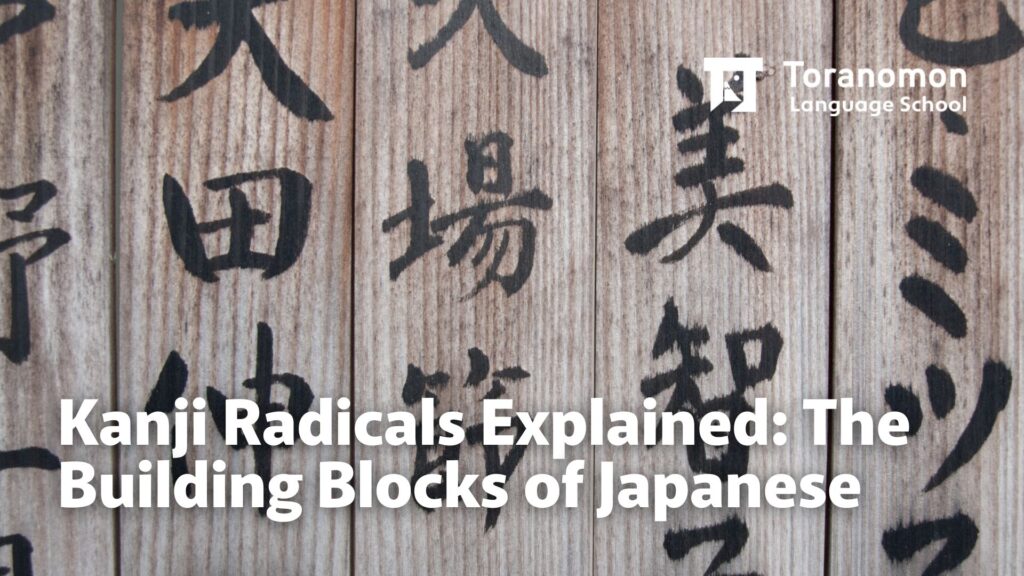
If you have started learning kanji, you may have noticed that many characters share familiar parts. These repeating elements are called radicals (部首 “bushu”), and they are one of the most powerful tools for understanding and remembering kanji. By learning radicals, you unlock patterns that make kanji study easier, faster, and much less overwhelming. What Are Radicals? Radicals are the basic components that make up kanji. Think of them like the “alphabet” pieces inside more complex characters. Each radical usually carries its own meaning or theme. For example, the radical for “water” (氵) appears in kanji related to liquids, like 海 (umi, ocean) and 酒 (sake, alcohol). There are around […]